LUX participates in the national and European ALMA 2040 reflection
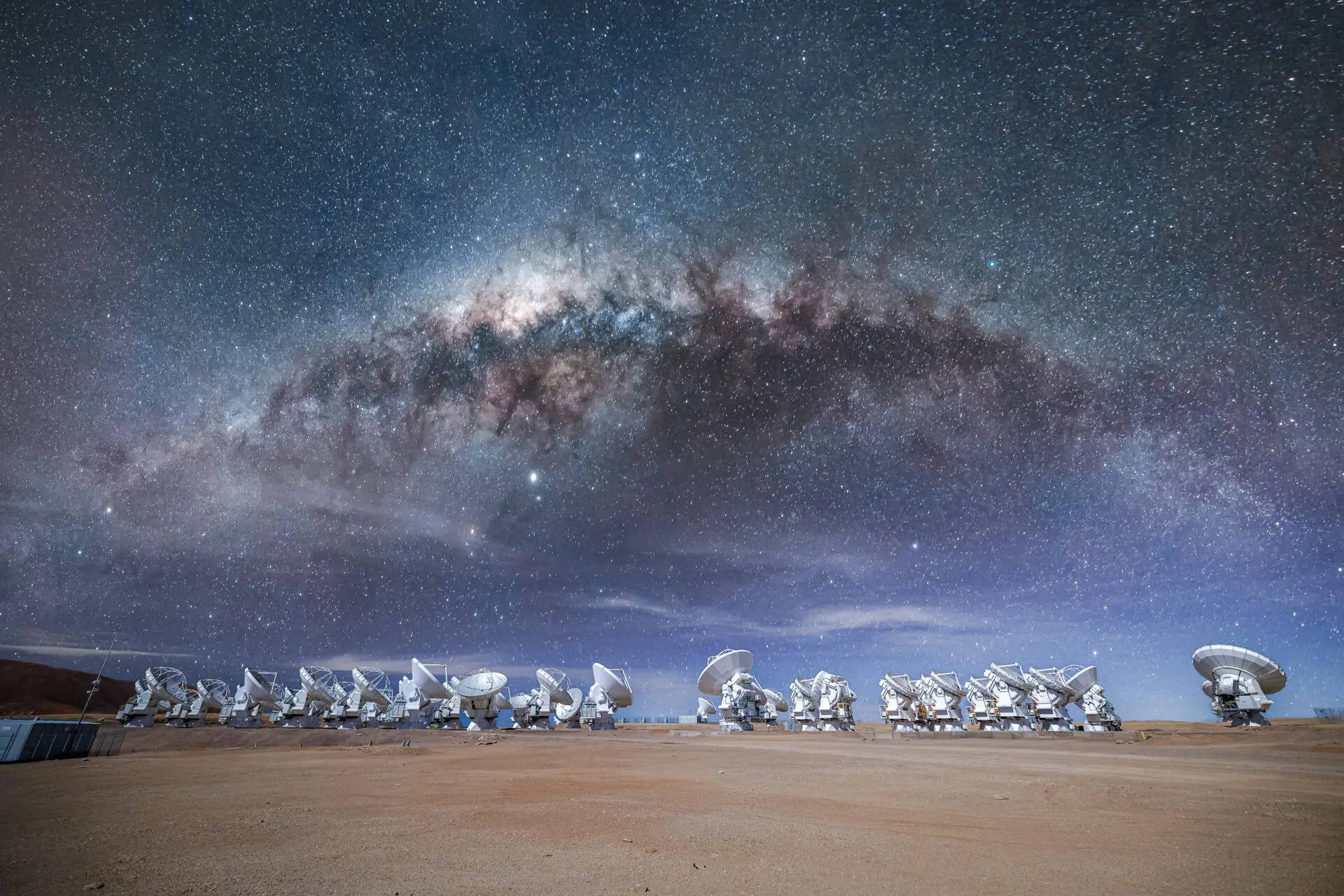
What will be the next major observatory at millimetre and submillimetre wavelengths by 2040 ? What successor to ALMA, the "Atacama Large Millimeter/submillimeter Array", the large radio telescope co-financed by Europe via the European Southern Observatory (ESO) alongside North America, Asia and Chile, and which has revolutionized our understanding of the cold Universe ? As part of a call for ideas called Expanding Horizons, Transforming Astronomy in the 2040s, ESO is currently consulting the European astrophysical community and collecting proposals for the next major European astronomy infrastructure, following the Extremely Large Telescope that is being built in Chile.
Under the banner ALMA2040, the European millimetre and submillimetre community is therefore organising itself to identify the key scientific questions by 2040 and to propose an ambitious concept. About thirty "white papers" on the science of a next-generation mm/submm observatory were submitted to ESO in December 2025
On the French side, reflection is also underway. A ALMA2040 workshopwas held on 26 and 27 March 2026 at the IAP, co-organised by LUX researchers, and financially supported by the Astrophysics of the Cold Universe and Galaxies and Large Structures APIs of the Paris Observatory. The LUX teams have a number of intensive users of ALMA, with around twenty publications per year using ALMA data ; they actively participate in the national millimetre and submillimetre radio astronomyobservation service and have contributed to ALMA2040’s working groups and white papers.
source
For two days, the participants debated the science they would like to do with this future telescope, its technical specifications, synergies with large telescopes on the ground and in space such as the ELT, the SKA, Euclid, Webb. The discussions and conclusions of this workshop will strengthen the French involvement in the project in response to ESO’s "Expanding Horizons" call for projects, which should be published in the3rd quarter of 2026. The next stop will be from 13 to 17 July at ESO (Garching), with the workshop "Expanding Horizons : What are the astronomical challenges of the 2040s ?", with the main objective of debating the major scientific challenges for tomorrow’s astrophysics and the infrastructures that will be needed to meet them.
Contacts :
Maryvonne Gerin équipe Milieu interstellaire et plasmas, maryvonne.gerin at observatoiredeparis.psl.eu
Philippe Salomé équipe Galaxie et cosmologie, philippe.salome at observatoiredeparis.psl.eu