
SVOM space mission : scientific assessment of the first year of operations
After a year of scientific operations for the French-Chinese space mission SVOM (Space-based multi-band astronomical Variable Objects Monitor), the French teams presented on April 23 an initial assessment showing that SVOM is fully fulfilling its promises — and even exceeding them.
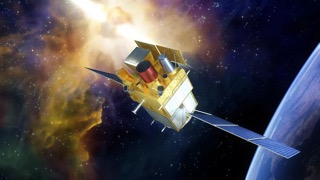
SVOM, launched on 22 June 2024, is dedicated to the detection and study of high-energy events known as gamma-ray bursts, which originate from supernova explosions or mergers of compact stars. It is a collaboration between two national space agencies, the China National Space Administration (CNSA) and the Centre National d’Études Spatiales (CNES), with contributions from the CEA and the CNRS for France.
A very promising first assessment
First quantitative assessment : SVOM has detected no fewer than 285 bursts, a quarter of which had not been detected by other space systems (Swift, Einstein Probe or Fermi). This is an important statistic that also makes it possible to detect events that do not fit into one of the two well-known populations of gamma-ray bursts : long bursts thought to be due to supernovae, and short bursts linked to the coalescence of two neutron stars.
For example, SVOM detected a burst that repeated several times in a single day, a completely new phenomenon that is not yet well understood.
Most bursts detected by the ECLAIRS instrument have been followed up with multi-wavelength observations : their afterglow emission is detected in X-rays in 77% of cases and in visible or near-infrared wavelengths in 66% of cases. This is essential for determining key information such as their distance and environment.
Thanks to the efficient system for locating bursts, broadcasting alerts in near real time, and mobilizing ground-based telescopes, nearly half of the GRBs detected by SVOM have a measured redshift and therefore a known distance.
Exploring the distant Universe
SVOM has also demonstrated its ability to detect very distant bursts, particularly thanks to the sensitivity of the ECLAIRS instrument in hard X-rays. One of the mission’s main goals is to trace star formation in the most distant galaxies, since gamma-ray bursts mark the end of massive stars’ evolution.
The event GRB 250314A was identified as the signal from a supernova in a galaxy at a redshift of 7.3 — only 730,000 years after the Big Bang, during the so-called reionization era of the Universe. This is by far the most distant supernova ever detected, yet its characteristics are remarkably similar to those of supernovae in the nearby Universe.
This important result required the mobilization of several ground-based telescopes (ESO’s VLT, Grantecan in the Canary Islands) as well as the James Webb Space Telescope. Multi-wavelength astronomy requires strong coordination between observatories and teams.
A versatile observatory
Finally, more than 60% of SVOM’s observation time is devoted to an open observatory-type program that takes advantage of its capabilities in X-ray, visible, and gamma-ray observations. Several dozen transient sources have already been observed, for example a thermonuclear X-ray burst from a neutron star (SVOM observes a thermonuclear explosion on a neutron star).
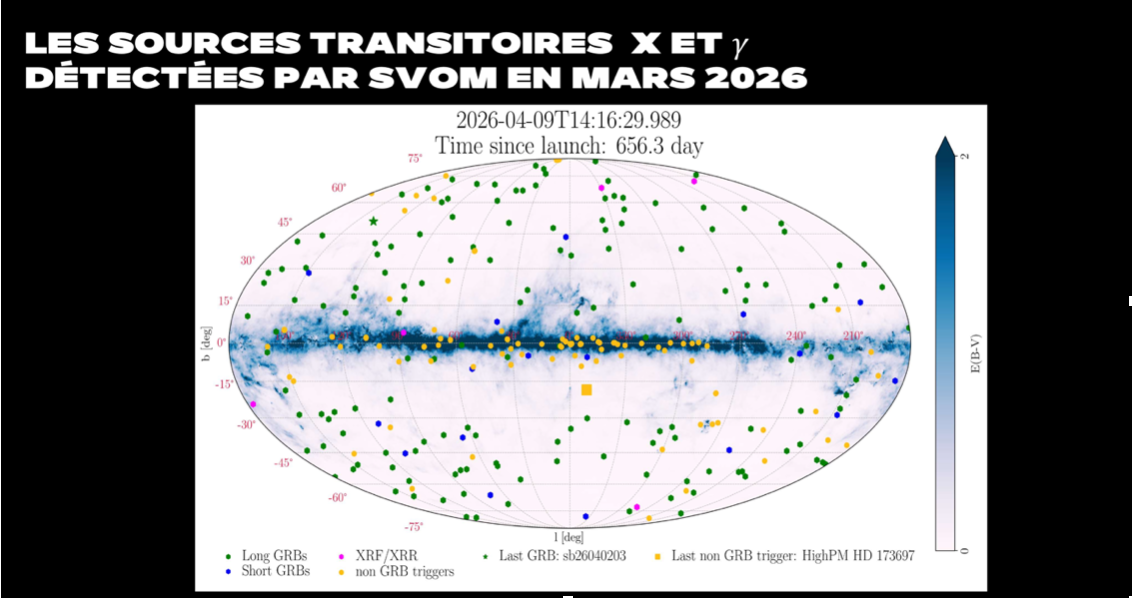
This already represents a very fruitful harvest for the Franco-Chinese SVOM mission, which is expected to continue observations for at least two more years. Given the excellent condition of all instruments, SVOM could potentially operate for a decade or more.
Practical information
Contact at LUX : Susanna Vergani
More information : www.svom.eu
CNES page : SVOM project
Instruments on board SVOM
SVOM is equipped with two gamma-ray instruments (ECLAIRs and GRM) to detect the prompt emission of gamma-ray bursts, as well as an X-ray telescope (MXT) and an optical telescope (VT). The latter is reoriented within minutes after a GRB detection to identify the optical counterpart of the afterglow.
Information on the burst position in the sky is also transmitted to the ground in less than a minute, allowing large telescopes to rapidly point toward the event and observe it.
This synergy between space- and ground-based observations, combined with multi-wavelength capabilities, is a key scientific strength of the SVOM mission.
The role of LUX in the SVOM collaboration
LUX is responsible for the VT analysis pipeline module that identifies the optical counterpart of GRBs. The team is also strongly involved in follow-up observations with major ground-based telescopes such as ESO’s Very Large Telescope (a LUX researcher serves as Mission Scientist for this ground-based program).
In addition, LUX contributes to studies of synergies between SVOM and other major facilities such as the Vera Rubin Observatory, gravitational wave detectors LIGO and Virgo, and future observatories like CTAO and SKAO.