
ALMA2030 : a new step in exploring the cold Universe
Since scientific observations began in 2011, the ALMA interferometer has continued to revolutionize millimeter and submillimeter wavelength astronomy and the observation of the cold Universe. Combining high spatial and spectral resolution with ultra-sensitive, low-noise observations, it has led to a better understanding of our cosmic origins : the formation of planets and protoplanetary disks, the evolution of galaxies and merger events such as the Antennae system, which trigger episodes of intense star formation, and interstellar gas clouds where ALMA has revealed filamentary structures and regions of fragmentation with unprecedented precision.
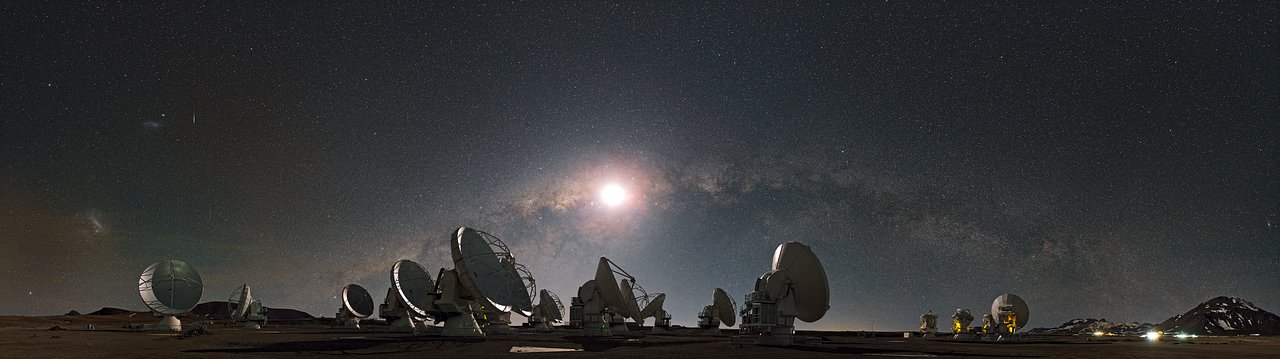
ALMA has proven essential for studying the early Universe as well as bodies in the Solar System. It has also enabled major advances in prebiotic chemistry, including the discovery of complex organic molecules in young stellar systems. In 2019, it also played a key role in the Event Horizon Telescope (EHT) collaboration, contributing to the very first image of a black hole.
ALMA’s partners — Europe, North America, and East Asia — together with the host country Chile, are now embarking on a new ambitious phase as part of the ALMA2030 plan. The goal is to significantly increase wideband sensitivity (WSU : Wideband Sensitivity Upgrade)
Learn more
of the heterodyne receivers that form the core of its telescopes and that use ultra-sensitive detector elements known as “SIS” (Superconductor–Insulator–Superconductor).
This modernization represents a major technological leap that will allow ALMA to observe the Universe with unprecedented precision and efficiency. By expanding the scope and sensitivity of its observations, ALMA will open entirely new perspectives for understanding the cosmos.
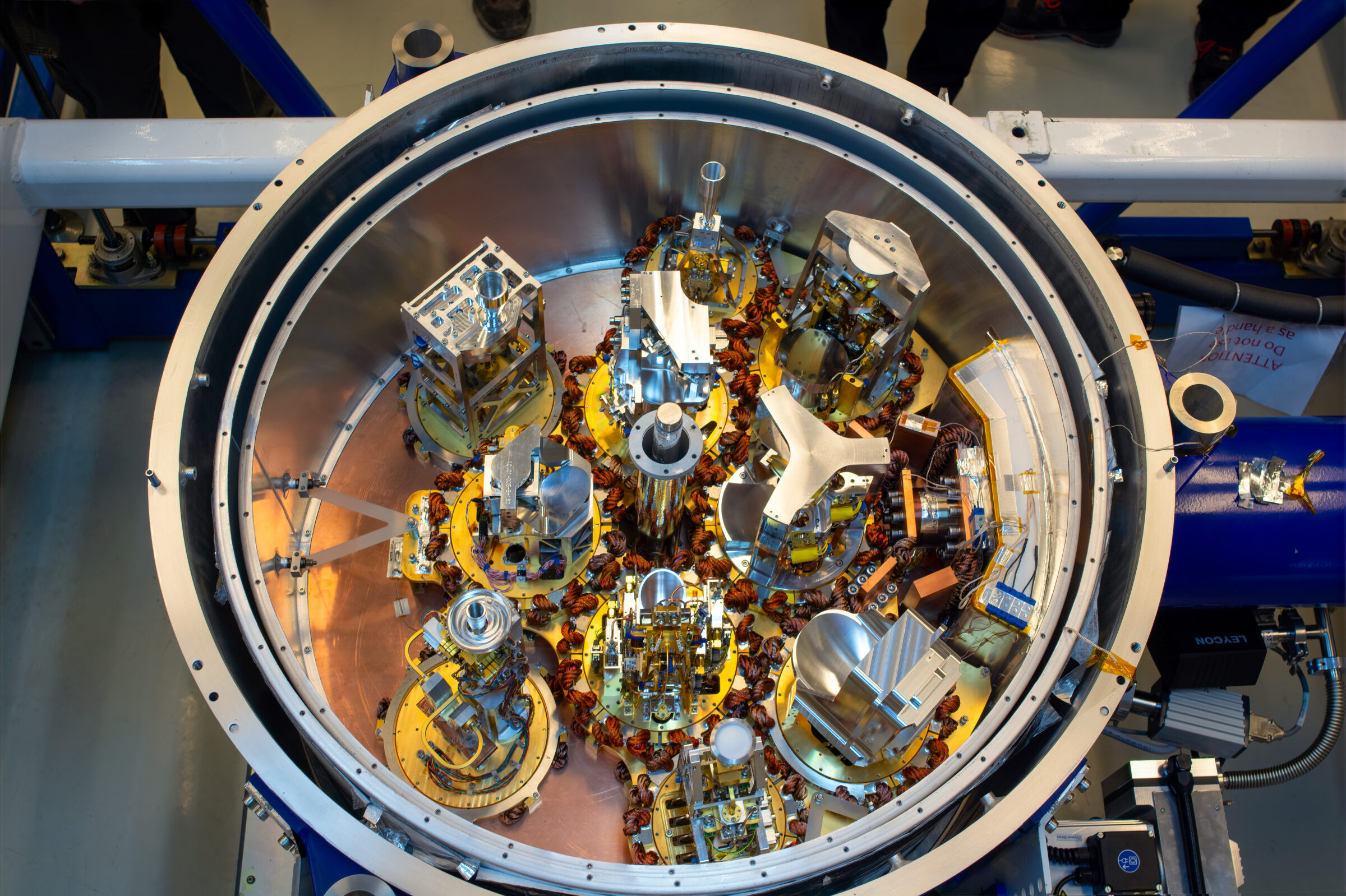
The Instrumental Research and Development group at LUX (See the team)
has recognized expertise in SIS detectors for the submillimeter range, with a key contribution to channel 1 of the HIFI instrument on ESA’s Herschel space mission. As part of the WSU program, the group has been awarded an ESO research contract to contribute to the development of the next generation of SIS detectors for Band 9 : one of ALMA’s submillimeter windows, centered at a wavelength of 0.45 mm.
The kick-off meeting, held on April 20 at the Paris Observatory, brought together the ESO team and the three study partners : the Superconducting Detectors and Instrumentation team at LUX, the Department of Astrophysics at the University of Oxford (United Kingdom), and the University of Groningen / NOVA (Netherlands). These three partners have highly complementary roles, with the University of Oxford in charge of the design of the SIS junctions, the LUX team defining the fabrication process and producing the SIS devices, and NOVA responsible for their characterization.
This study is expected to lead to a choice between two technical options, with an ambitious sensitivity goal. One important aspect will be to demonstrate the feasibility of producing series of several dozen receivers, as ALMA consists of no fewer than 66 telescopes. See you in three years for the final results !
